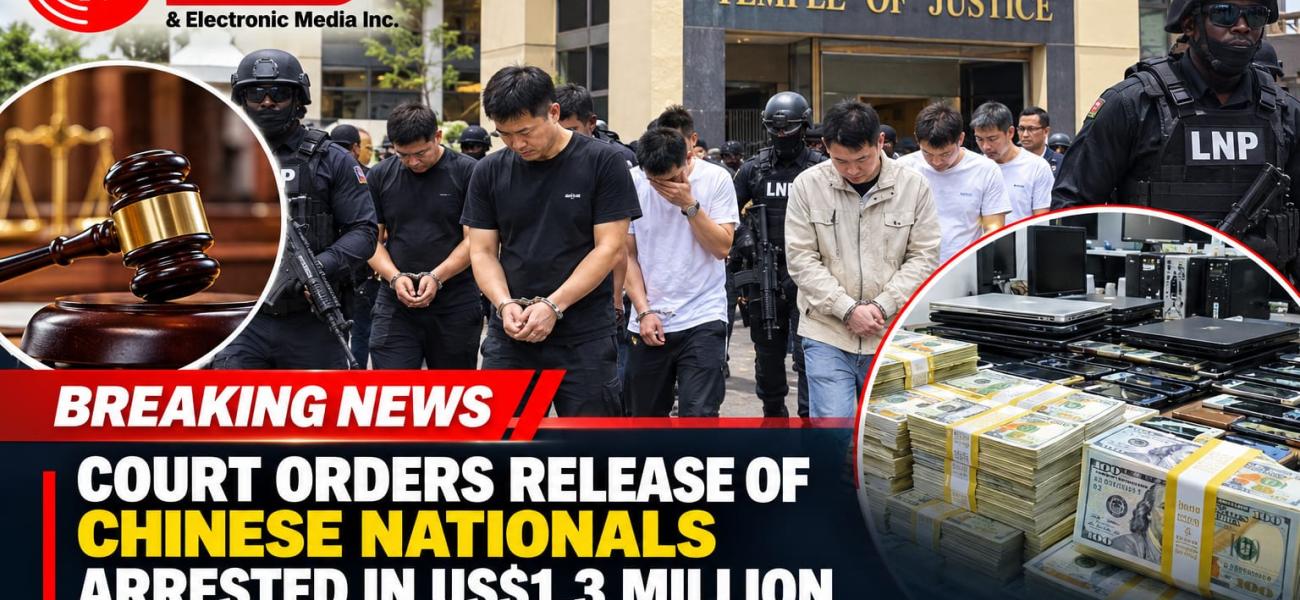
Monrovia –Criminal Court ‘B’ at the Temple of Justice in Monrovia has ordered the immediate release of several Chinese nationals arrested by the Liberia National Police (LNP) in connection with amassive US$1.3 million suspected counterfeit currency investigation.
The dramatic court intervention came after defense lawyers filed a writ of habeas corpus, accusing the police of illegally detaining their clients beyond the constitutional limit without charge.
The detained individuals are among 67 foreign nationals, mostly Chinese citizens, who were rounded up during a police raid in Paynesville last week — an operation that Police Inspector General Gregory Coleman described as one of the biggest crackdowns on financial crime this year.
IG Coleman, speaking at the Ministry of Information’s regular press briefing on Thursday, disclosed that acting on intelligence, officers of the LNP raided a compound in the Paynesville area outside Monrovia.
During the operation, police said they discovered more than US$1.3 million in suspected counterfeit United States currency, over 200 mobile phones, more than 50 computers, and sophisticated internet connectivity equipment believed to be used in an online scam and money laundering network.
Coleman displayed photos of bundles of dollar bills and electronic gadgets allegedly seized, telling journalists that investigations were ongoing and that the suspects were in custody helping police with the probe.
But barely 24 hours after that press conference, the case took a legal turn.
Attorney Joseph Howe and Counsellor Joseph Kumeh, representing the detained Chinese nationals, filed a petition for a writ of habeas corpus before Criminal Court ‘B’, challenging the legality of their continued detention.
In the petition, the lawyers argued that their clients had been held for days without being formally charged and without being brought before a court, in violation of Liberia’s Constitution.
Presiding Circuit Judge Paye Suah agreed to hear the petition and immediately issued a writ ordering the Ministry of Justice and the Liberia National Police to produce the living bodies of the petitioners before the court.
Those named in the court’s writ include Xing Guodung, Wu Liqing, Liu Yao, Zhou Guohui, Zhao Geng, Gao Yangong, Chen Minjie, Wang Zhihong and several others.
Judge Suah, in a strong order signed by Clerk of Court Varney Dafuwah, further directed that the named petitioners be immediately released from police custody and turned over, along with their personal belongings, to the Sheriff of the court pending a full hearing.
The court scheduled a hearing for Friday, October 9, 2026, at 10:00 a.m., at which IG Coleman and other responsible officers of the LNP and Ministry of Justice are expected to appear and justify why the individuals were being held.
Legal sources say failure to comply with the order could result in contempt charges against the police leadership.
At the heart of this case is Article 21 of the 1986 Constitution of Liberia.
Article 21(f) states that any person arrested or detained must be charged and presented before a court of competent jurisdiction within 48 hours. Article 21(g) guarantees the right of habeas corpus — the right of any detained person to challenge the legality of their detention before a judge.
A writ of habeas corpus, often called the great writ of liberty, compels authorities to bring a detained person before the court and provide lawful justification for holding them. If the court finds the detention illegal, it must order release.
Defense lawyers argue that the police violated both provisions by holding the foreign nationals for several days, parading them before the media, without filing formal charges.
Police have not yet publicly responded to the court order.
Judicial observers caution that Judge Suah’s order does not mean the Chinese nationals have been declared innocent or that the counterfeit case has been thrown out.
The release order deals only with the legality of the detention, not the merits of the criminal allegations. The police can still investigate, and if they have evidence, formally charge the suspects and proceed through lawful prosecution.
The suspected US$1.3 million in fake currency, the phones, computers and internet equipment remain in police custody as evidence, subject to further forensic examination and court processes.
The case is being closely watched because it tests the balance between aggressive law enforcement against transnational financial crime and respect for constitutional due process.
Liberia has in recent years seen a rise in the arrest of foreign nationals for alleged fraud, counterfeiting and illegal online operations, often in private residences in Paynesville, Congo Town and other parts of Montserrado County. Several of those cases have collapsed in court due to procedural errors and failure to meet the 48-hour rule.
The case could set a major precedent on how Liberian authorities handle large-scale arrests involving foreign nationals and complex financial crimes — and how strictly the courts will enforce constitutional safeguards regardless of nationality.