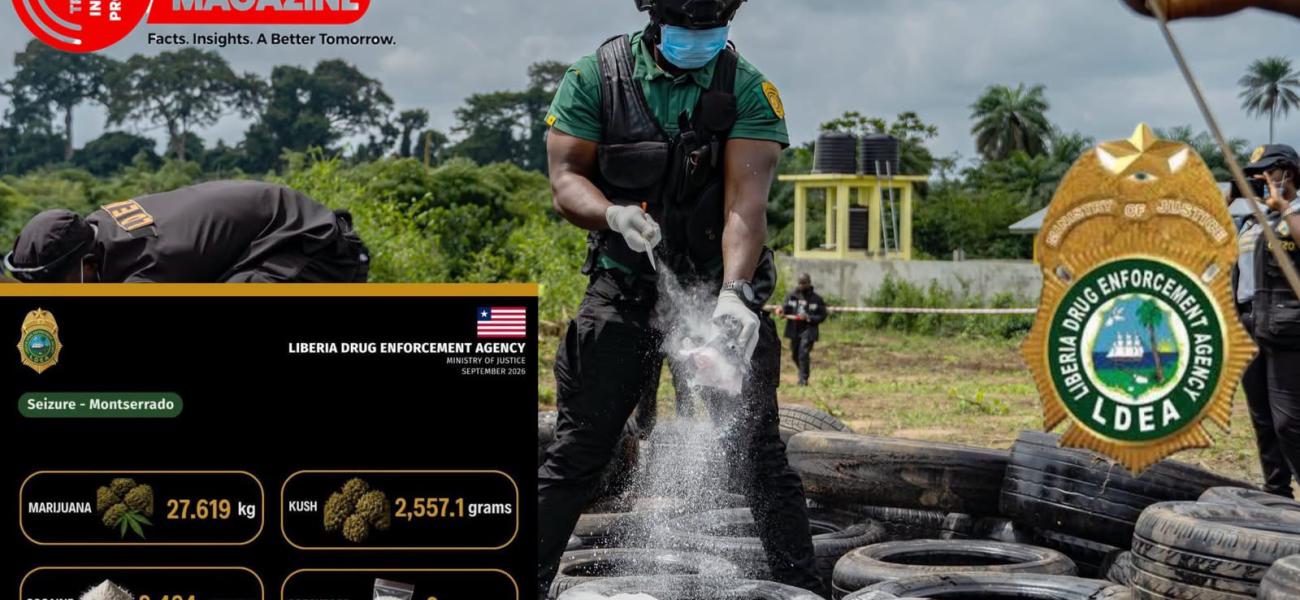
MONROVIA – The Liberia Drug Enforcement Agency (LDEA) is being lauded for taking a bold step toward transparency by organizing and publishing data on its anti-drug operations, but governance advocates say the agency must now go a step further put the data online in real-time.
In a statement issued Thursday, HardFacts Global Innovations, a governance and national security think-tank, commended the LDEA for its recent data-reporting initiative, describing it as a critical shift toward accountability and evidence-based policymaking in Liberia’s fight against illicit drugs.
The group is urging the LDEA to launch a live, public digital dashboard that would track enforcement activities nationwide including seizures, arrests, drug hotspots, prosecution outcomes, and prevention efforts.
Liberia is grappling with a worsening drug crisis that is fueling crime, affecting youth, and posing a serious threat to public health and national security.
For years, the public has had to rely on occasional press briefings and press releases to know what the LDEA is doing. A centralized, live portal, advocates argue, would change that.
Such a platform would allow policymakers, security agencies, health workers, development partners, researchers, journalists and ordinary citizens to see emerging trends, know which communities are most affected, and measure whether interventions are actually working.
The portal could display geographic trends, monthly seizure statistics, types of drugs confiscated, and the status of cases in court all without compromising ongoing investigations or exposing vulnerable individuals.
“Beyond transparency, it will help authorities direct limited resources to the communities that need them most,” HardFacts noted.
The think-tank also pointed to the Liberia Revenue Authority (LRA) as a model for digital transformation in the public sector.
Under Commissioner General Dorbor Jallah, the LRA has rolled out digital systems to improve revenue tracking, data management and institutional transparency. HardFacts believes a technical collaboration between the LRA and LDEA could fast-track the creation of a drug enforcement dashboard.
Such partnership, however, would need strong data verification protocols, cybersecurity safeguards, and a clear framework for who maintains and updates the platform.
Governance experts stress that Liberia’s drug problem cannot be solved by enforcement alone. It requires a coordinated response involving law enforcement, the Ministry of Health, schools, rehabilitation centers, community groups and international partners.
Reliable, timely data is key to that coordination — to know whether enforcement is reducing supply, whether prevention programs are reaching at-risk youth, and where rehabilitation services are urgently needed.
A public dashboard would also build public trust by allowing citizens to track measurable progress rather than depending solely on periodic government announcements.
While praising the LDEA leadership for the current progress, HardFacts said the next logical step is to institutionalize it.
“A public dashboard would not, by itself, eliminate drug trafficking or substance abuse. But it could strengthen the country’s ability to monitor trends, evaluate interventions and respond more effectively,” the group said.