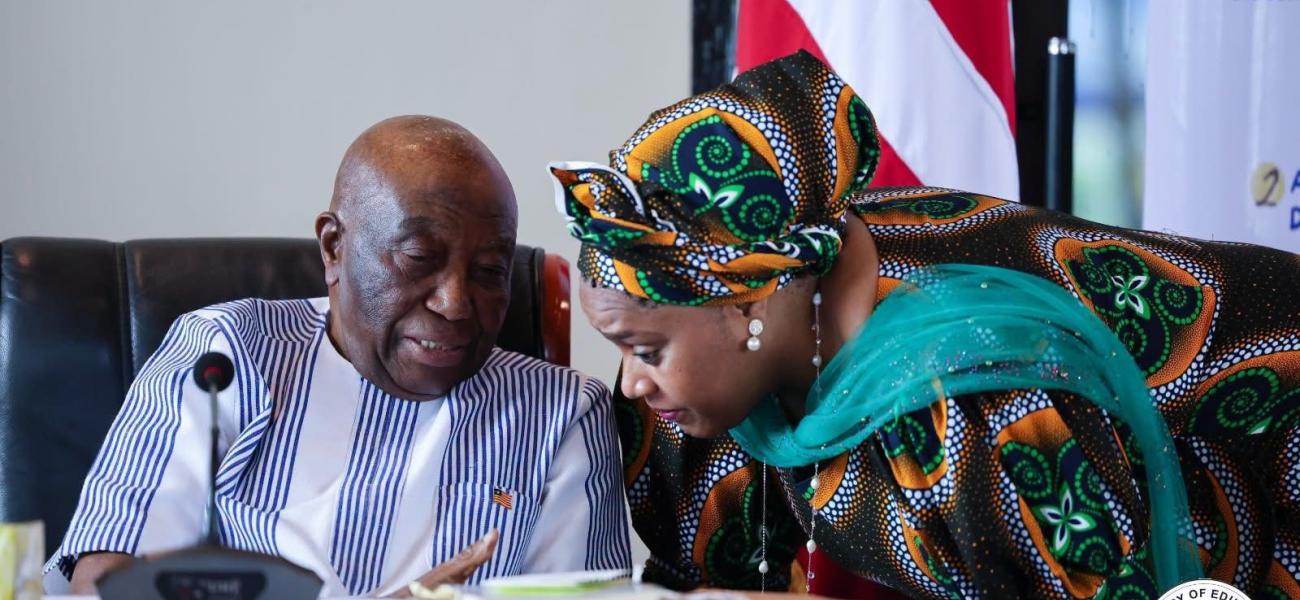
The Ministry of Education in August of 2026 embarked on its school feeding and the Back to My Classroom campaign including free primary school registration aimed at returning 250,000 children to school by 2029.
As part of these efforts, the Government has signed a new three-year memorandum of understanding with the United Nations World Food Programme (WFP) to strengthen and sustain the national school feeding programme.
Under the agreement, the Government will assume greater responsibility for planning, financing and implementing school feeding, while WFP will continue to provide technical and institutional support.
Education Minister Jarso Maley Jallah highlighted that school meals are important to keeping children in school, improving attendance and concentration, and supporting learning. The Ministry also plans to expand its School Connect digital platform to more than 300 schools to improve real-time monitoring of meal deliveries and strengthen accountability.
WFP Country Director Agbessi Komla Amewoa described the agreement as the formal start of the 2026/27 school feeding programme and reaffirmed WFP's commitment to supporting the country. The partnership is expected to help strengthen national systems and increase government ownership and financing of school feeding over time.
Free Primary School Registration
Alongside the school feeding initiative, the Government is removing registration fees for children enrolling in public schools from kindergarten through Grade 6.
Minister Jallah said the policy is intended to remove a major financial barrier to school enrollment. Schools will receive support to cover costs associated with the policy through direct school financing under the Liberia EXCEL Project, the Equitable Funding Formula and the Government's longer-term Education Investment Strategy.
The minister also warned public schools against replacing registration fees with unauthorized charges. To ensure compliance, the Ministry of Education is deploying 160 monitoring and evaluation interns across the country. Working with district and county education officials and other relevant institutions, the interns will help identify and report violations.
The measure is designed to expand access while ensuring that schools continue to receive the resources required to operate effectively.
Bringing 250,000 Children Back to School
These interventions form part of the Government's broader effort to address the barriers keeping children out of school. President Joseph Nyuma Boakai has renewed his administration's commitment to the Back to My Classroom campaign, which was launched in 2024 with a goal of returning 250,000 children to school by 2029.
The first phase, being implemented in 2026, targets 80,000 children across seven priority counties. At a mid-term review of the campaign's national steering committee, President Boakai stressed that achieving the target would require sustained collaboration among government institutions, local authorities, communities, families, schools, civil society organizations and development partners.
He also endorsed the expansion of the strengthened campaign model to six additional priority counties, following the establishment of the first county-level structure in Gbarpolu.
Minister Jallah noted that enrolling children is only the beginning. Poverty, long distances to school, disability, lack of birth certificates and inadequate school facilities remain significant barriers to enrollment, regular attendance and retention.
The Back to My Classroom campaign therefore brings together the education, health, gender, children and social protection, local government, finance and development sectors, along with national statistics officials, international partners and civil society organizations.
Since its launch, the initiative has drawn lessons from a pilot in Grand Bassa, established a county steering committee and secretariat in Gbarpolu, and developed systems for referrals, individual child tracking and monitoring continued attendance.
The ultimate goal of these initiatives however, is not simply to bring children into classrooms, but to create the conditions that enable them to remain in school and succeed.